
How I Use My Idea Book
A creative habit essential to my practice

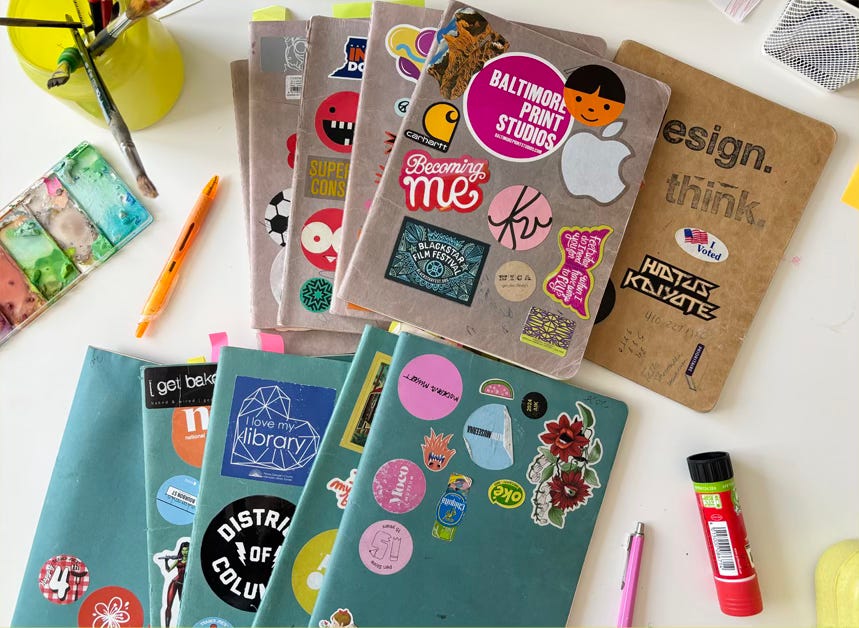
For the last fifteen years I’ve kept what I call an idea book. Over that time I have amassed twelve books. These blank pages have been a place of refuge, a space for me to dream and to collect the many ideas that frequently cross my mind.
This process allows me to clear my headspace so I don’t have to remember every thought or concept. Instead they are safely captured and it is comforting to know I can always come back to them later.
My idea books are usually used to brainstorm, mind-map, and do quick doodles for a concept. It also functions as a place to plan, to calculate money coming in and out, and write down my creative goals and to-dos. Many books and illustration projects started as a quick note or thumbnail sketch on a page from one of these notebooks.
In recent years my idea books have been used more for planning and strategizing how to execute said dreams and ideas. While I do keep a digital calendar and capture notes in the Notes app, analog writing in these notebooks have become a daily practice that anchors me and keeps me organized. And quite honestly I remember better in written form.
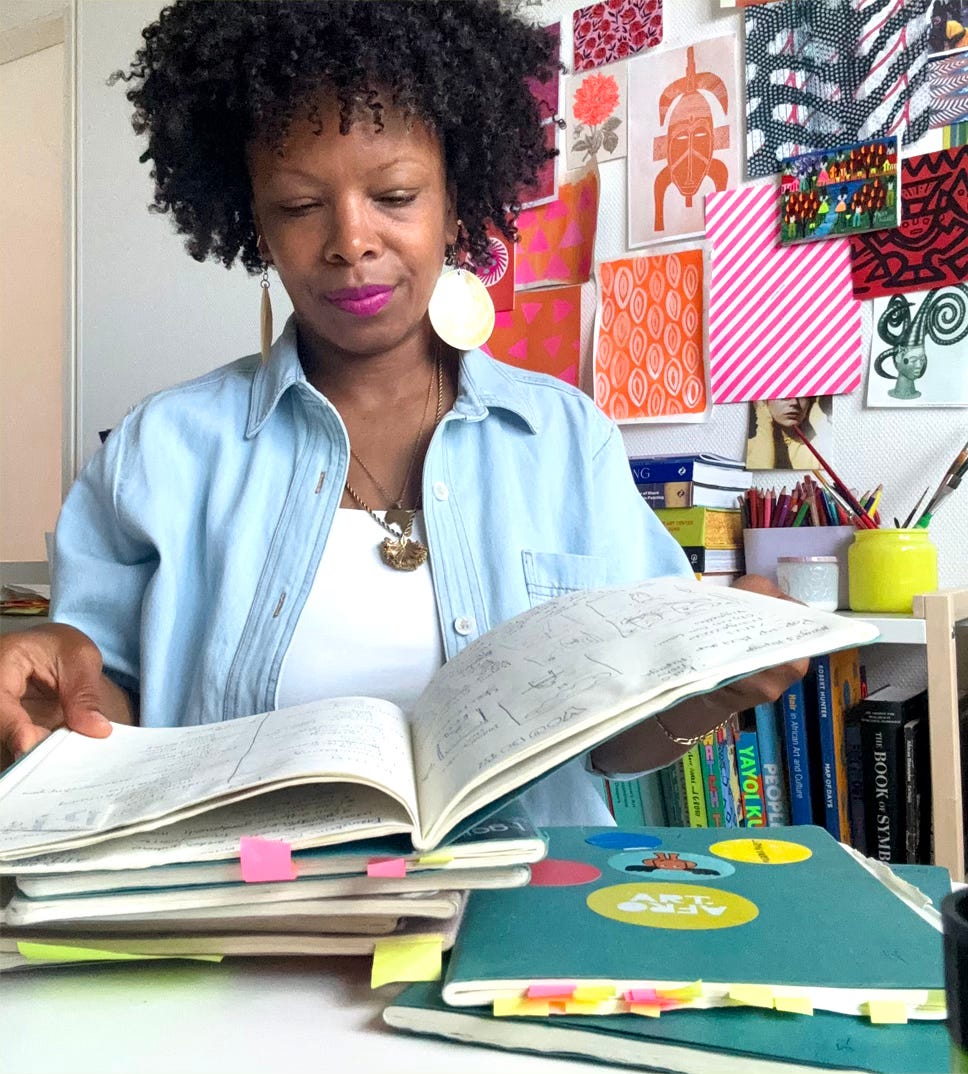
Recently, on Instagram, I shared a glimpse of my collection of these idea books and the three reasons why maintaining them is one of my essential creative habits. Since the post, there have been questions asking for more specific details about how I use the notebook, so I decided to share them here.
What kind of notebooks I use:
I’ve used Moleskine Cahier XL unlined since the very beginning of this practice. I didn’t choose this brand for any particular reason. The notebook was introduced to me during a faculty meeting when I was teaching at Stevenson University back in the day. Our department chair gifted each faculty member a notebook (in kraft color) and as an activity, she invited us to stamp the cover with words related to visual communication design (our department).
Since then I have liked the style and colors and just kept going with the same notebook for consistency. Although the colors have changed over the years (first kraft, gray, then Brisk blue), keeping the same size and style makes it easy to store them all together and for my brain to easily recognize them for their specific purpose.
Aside from capturing ideas, here is how I use my books for planning (these are fairly new practices I started within the last two years or so):
Daily use
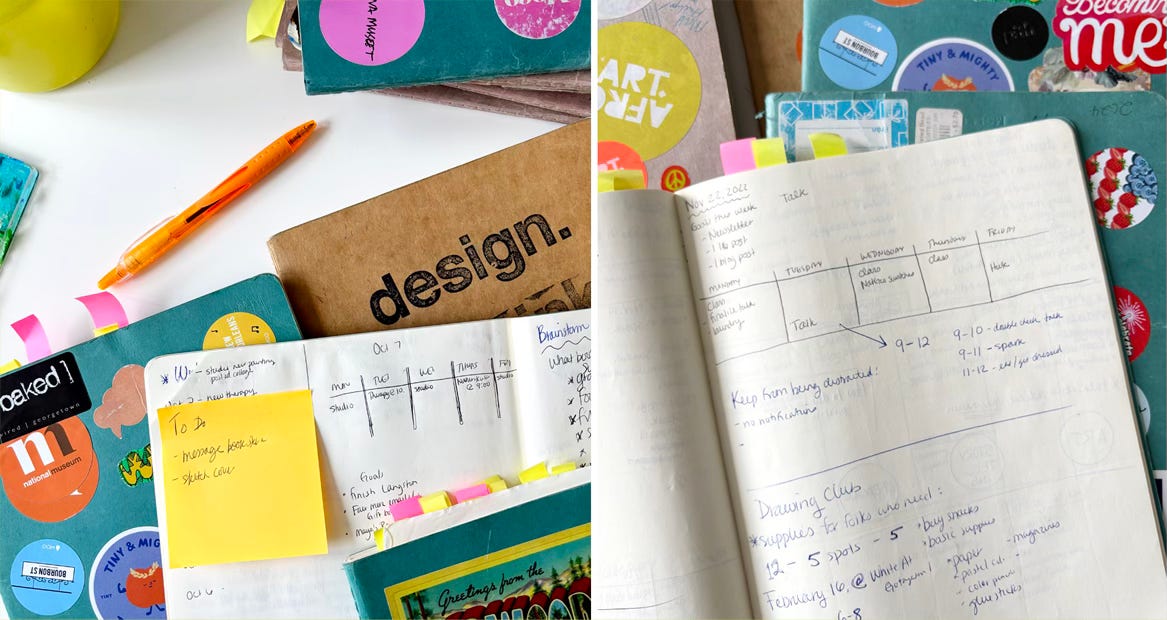
Usually the night before (or if I didn’t get around to it, then the morning of) I plan how I’d like my day to go for the following day. To help me organize the day I write down my tasks in hourly segments from 9:00-4:00. Those tasks are generally related to the goal or assignment that needs to be completed that week, but also includes lunch breaks, time for drawing or research, meetings or any other thing that needs to happen during the day.
If there is a meeting, the notebook is also where I write down what I will present and/or questions, and it’s where I document any notes from that meeting (like question responses, follow-up needs, etc.).
Weekly use
Every Friday or Sunday night I plan the following week. I make a small five day grid, one column for each day of the week with the weekday at the top. Above the grid I write the week date (like week of June 15th) and then I write 3-5 goals for that week. (Again, my daily tasks usually coincide with reaching those goals.) It always feels good to go back and cross out completed tasks and see what was achieved that week, but honestly I don’t always go back right at the end of the week to make sure.
If you don’t already keep an idea book and this inspires you to start one here are a few tips:
Choose the format that works for you. I prefer blank pages because they give me the freedom to draw as well as keep notes. I also love that these particular notebooks open flat, and that the cover can be customized. Covering mine with doodles and stickers is a way I personalize mine.
Don’t overthink it or feel like anything has to be perfect. Y’all, my pages are MESSY, sometimes stained from a spill, notes with misspellings, many unfinished weekly plans and schedules, post-it notes, and even random grocery shopping lists. There are no rules. In fact, too many rules makes it harder to maintain. My only rule is that I finish the notebook before starting a new one.
Include dates, with the year as much as possible. It helps place that notebook in time. I add the year it was used and completed on the back, and I try to remember to add a date on the very first page when I start a new one.
Carry it with you when you can. Whether I’m going to a cafe, my kids’ judo practice, to a talk, a museum, out to lunch, I bring it along just in case an idea pops up or a I have a few minutes to jot some things down.
Reflect: How do you currently capture your ideas?
Prompt: If you do have an idea book write down 3-5 ways it helps you navigate your creative practice. Because it’s been such a natural part of my daily life, I did not realize how important this creative habit was for me until sharing it with others. Reflecting on how we benefit from a ritual can help honor its significance and therefore commit to doing it consistently. If you do not have a practice of writing down your ideas, think about why—perhaps you don’t need one or have other ways to remember your ideas.
Thank you! I was just trying to figure out how to capture and track my ideas!
Hi Andrea , I have tried every notebook on this planet, and in the end, I have found the Moleskine. XL is my best companion. To be honest, I am not a fan of Moleskine as I am a fountain pen user and therefore, I use a particular ballpoint pen for this. Thank you for sharing and opening your notebooks. Sometimes I cannot understand why I need permission to permit myself to be messy on the pages. Must be psychological! Thank you. And I look forward to reading more of your creative processes.